Speaking the Language of Success: How US Students Overcome English-Program Challenges at Foreign Universities

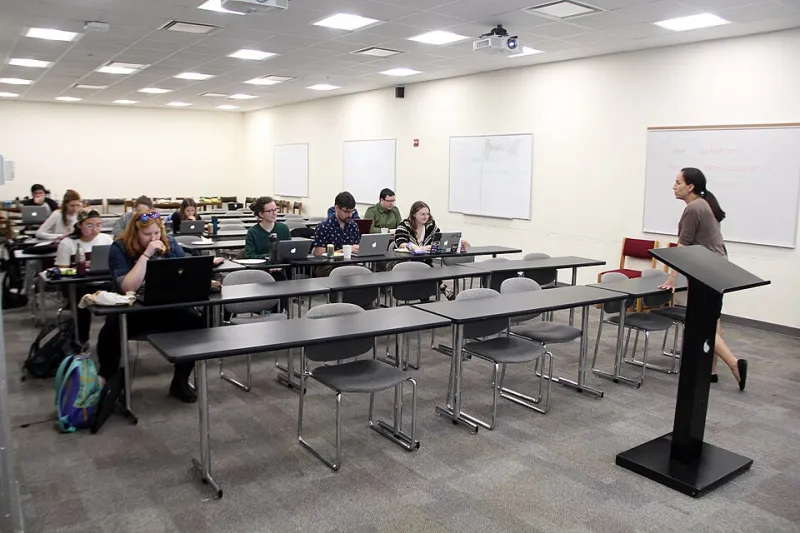
Photo: Dristi Manandhar, CC BY-SA 4.0, via Wikimedia Commons
The Assumption That Gets Students Into Trouble
Many US students assume that enrolling in an English-taught program at a European, Asian, or Latin American university means the language experience will mirror what they know from home. It rarely does. Professors whose first language is German, Dutch, or Mandarin bring distinct rhetorical patterns to their lectures. Peer study groups may default to a shared language that isn't English the moment the seminar ends. Even academic writing conventions—the structure of an argument, the expectations around citation, the tone of a thesis statement—differ meaningfully from what most American undergraduates were trained to produce.
None of this should discourage a motivated student. But it does mean that treating language as a non-issue is one of the more common planning mistakes US students make before departure.
What "English-Taught" Actually Means at International Universities
The designation "English-taught program" (sometimes called EMI, or English as a Medium of Instruction) is not a single, standardized experience. At institutions in the Netherlands, Scandinavia, and parts of Germany, EMI programs have been operating for decades and are tightly integrated into faculty development. Professors are assessed on their English-language instruction, course materials are produced natively in English, and student support services are equipped to assist international learners.
In contrast, some universities in Eastern Europe, Southeast Asia, or South America have only recently introduced English-taught tracks. In these settings, the program may be taught in English while surrounding infrastructure—administrative offices, student health services, housing contracts—operates primarily in the local language. US students who arrive expecting a fully English-immersive environment sometimes find themselves navigating bureaucracy in a language they haven't studied.
Understanding this distinction before you apply is essential. When researching programs through EduWings Study Abroad, it is worth asking specific questions: What percentage of faculty are native or near-native English speakers? Are all course materials published in English? Is academic advising available in English?
The Real Advantages of a Multilingual Academic Setting
Here is where the narrative shifts. The same environment that presents early challenges tends to produce unusually capable communicators over time. US students who complete degrees in multilingual settings consistently report improvements in several areas that domestic programs rarely develop as sharply.
Precision in written communication. When you cannot rely on colloquialisms, cultural shorthand, or the assumption that your reader shares your background, your writing becomes more deliberate. Students returning from programs in the Netherlands or South Korea frequently note that their academic writing grew more rigorous because ambiguity was simply not an option.
Active listening and comprehension under pressure. Following a lecture delivered by a non-native English speaker at full academic speed trains a kind of attentive listening that serves professionals well in international careers, multinational companies, and graduate seminars populated by scholars from around the world.
Cross-cultural collaboration. Group projects in international programs routinely pair American students with classmates from five or six different countries. Learning to build consensus, divide responsibilities, and present unified work across cultural communication styles is a skill that employers in virtually every sector now actively seek.
Practical Strategies for Classroom Participation
For many US students, the most anxiety-inducing element of international study is not the writing—it is speaking up in class. In some academic cultures, students are not expected to challenge professors or contribute unsolicited opinions. In others, participation is graded but takes a more formal, structured form than the freewheeling discussion common in American seminars.
The following approaches have helped US students find their footing:
- Prepare one specific question or comment before each class. Rather than hoping inspiration will strike, arrive with a prepared observation connected to the assigned reading. This removes the pressure of spontaneous contribution while still keeping you engaged.
- Use office hours strategically. In many international university systems, office hours are underutilized by local students. US students who attend consistently often build stronger faculty relationships than their peers—and gain clearer insight into what professors actually expect.
- Engage peer writing centers early. Most research universities with established EMI programs maintain writing centers staffed by tutors trained to assist non-native speakers. US students qualify for these services and should take advantage of them, particularly during the first semester.
Academic Writing Across Borders
American students trained in the five-paragraph essay model or the thesis-driven analytical paper sometimes struggle with the structural conventions expected in European or East Asian academic traditions. German academic writing, for instance, tends toward comprehensive literature review before any original argument is introduced. British-influenced systems prize a particular form of hedged, impersonal prose that can feel counterintuitive to students trained to write with a strong authorial voice.
The adjustment period is real, but it is finite. Most students report that by their second semester they have internalized the new conventions well enough to write fluidly. The key is to seek feedback early and often, treat the first major assignment as a diagnostic rather than a high-stakes performance, and resist the temptation to write the way you always have and hope the professor doesn't notice the mismatch.
Building Confidence Over the Long Term
Language confidence in an academic setting is not built through a single breakthrough moment. It accumulates through small, repeated acts of engagement: asking a question in a seminar, editing a classmate's draft in exchange for feedback on your own, presenting a research summary to a professor whose first language is not English.
US students who approach this process with patience—and who resist the impulse to self-isolate with other English speakers—tend to emerge from their programs with a communicative adaptability that is genuinely difficult to develop any other way. Language, in this context, is not a barrier to be cleared before learning can begin. It is part of the learning itself.
If you are evaluating English-taught programs abroad and want guidance on which institutions offer the strongest support infrastructure for US students, the advisors at EduWings Study Abroad can help you identify programs that match both your academic goals and your preparation level.